
Trimming branches off the roof and away from the wire to your house
A limb that brushes the shingles in July is scraping them bare by February. We lift branches back off roofs, gutters, chimneys and the service wire to the house from the bucket, and cut them back to a spot where the tree can close the wound.
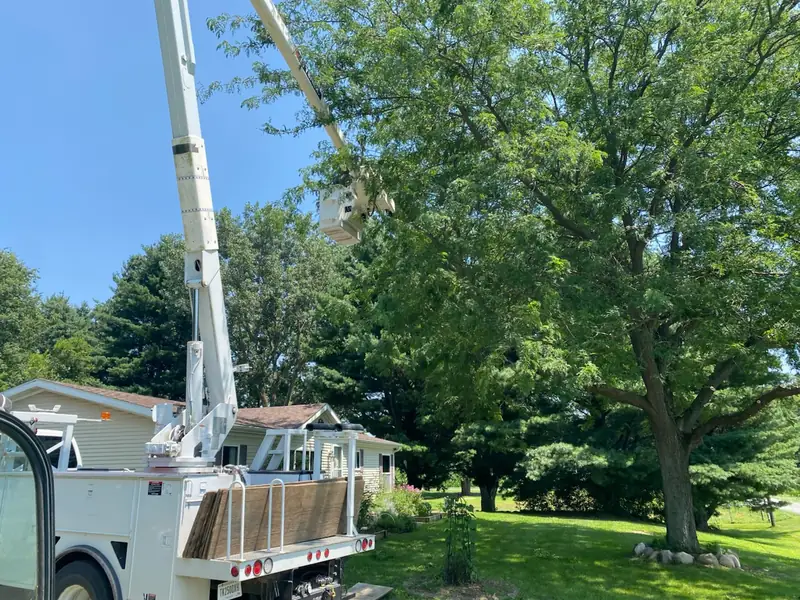
The short answer
Branches over your roof and around the wire that runs from the pole to your house can be trimmed back by a tree service. The main lines running along the road belong to the utility, and trees tangled in those are the utility's to clear, or to make safe before anyone else works near them.
Which wire is which
Look at where the power comes into your house. The single cable (or a bundle of twisted cables) that runs from the pole to a mast or bracket on your house is the service drop. The heavier wires strung pole to pole along the road, usually at the very top of the pole, are the primary distribution lines.
Clearance around the service drop is something we plan for on residential trimming jobs, and we'll tell you at the estimate if the utility should drop or de-energize the line first. Trees growing into the primary lines along the road are the utility's responsibility. Call them, not us, and never try to cut those yourself. If a limb is resting on any wire after a storm, stay back and call the utility first.
What branches do to a roof
The damage is slow and easy to miss from the ground. Limbs rub back and forth in the wind and wear the granules off asphalt shingles. Leaves pile up in the valleys and gutters and hold water against the roof edge. Shade and damp let moss get started on the north side. And every roof-level branch is a ramp for squirrels and raccoons looking for a gap in the soffit.
A common rule of thumb is to keep branches several feet back from the roof, so that when they sway in wind or sag under ice, they still don't touch.
How we cut them back
Clearance trimming is not topping. We don't stub a limb off at whatever point happens to line up with the eave. Each cut goes back to a side branch or to the collar where the limb meets the trunk, so the tree can seal it over and doesn't answer with a bush of fast, weak sprouts aimed right back at the roof.
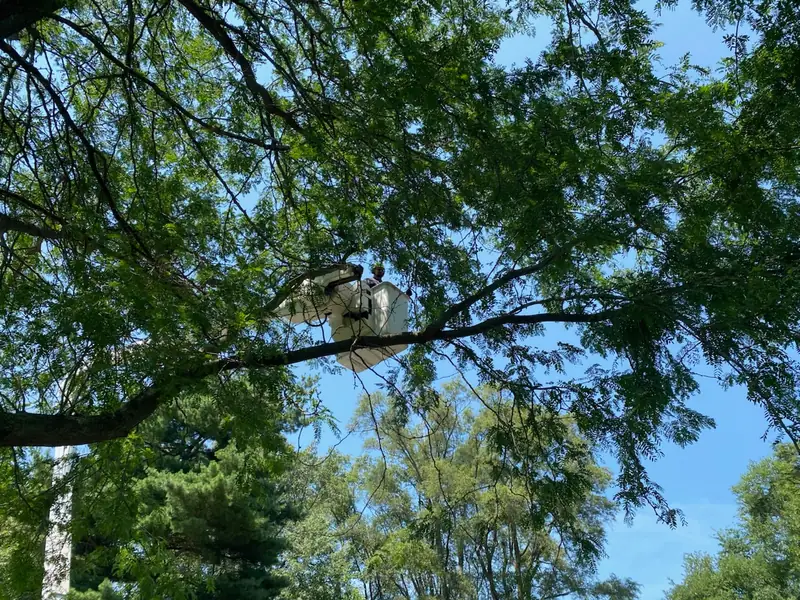
From the bucket, whoever is doing the cutting works right up at the roof line, lowers the pieces clear of the shingles and gutters, and the brush goes through the chipper on the ground.
How often to redo it
Fast growers like silver maple, cottonwood and willow can put a limb back on the shingles in two or three seasons. Oaks take longer. If you've had the same tree cleared before and it's already back, that's worth mentioning when you call. Sometimes the better long-term answer is taking the whole limb back to the trunk, and occasionally it's the tree.
More than clearance? Our full tree trimming service covers dead wood, thinning, and how often a yard tree needs attention.
Roof clearance around the area
Roof and wire questions
Utilities clear their primary lines along the road on their own schedule. Branches around the service drop to your house are usually the homeowner's to handle. Ask your utility what they cover where you live.
A cut in the middle of a limb leaves a stub the tree can't close, and it sprouts right back toward the roof. Working off a ladder next to a roof with a saw is also how a lot of people get hurt.